

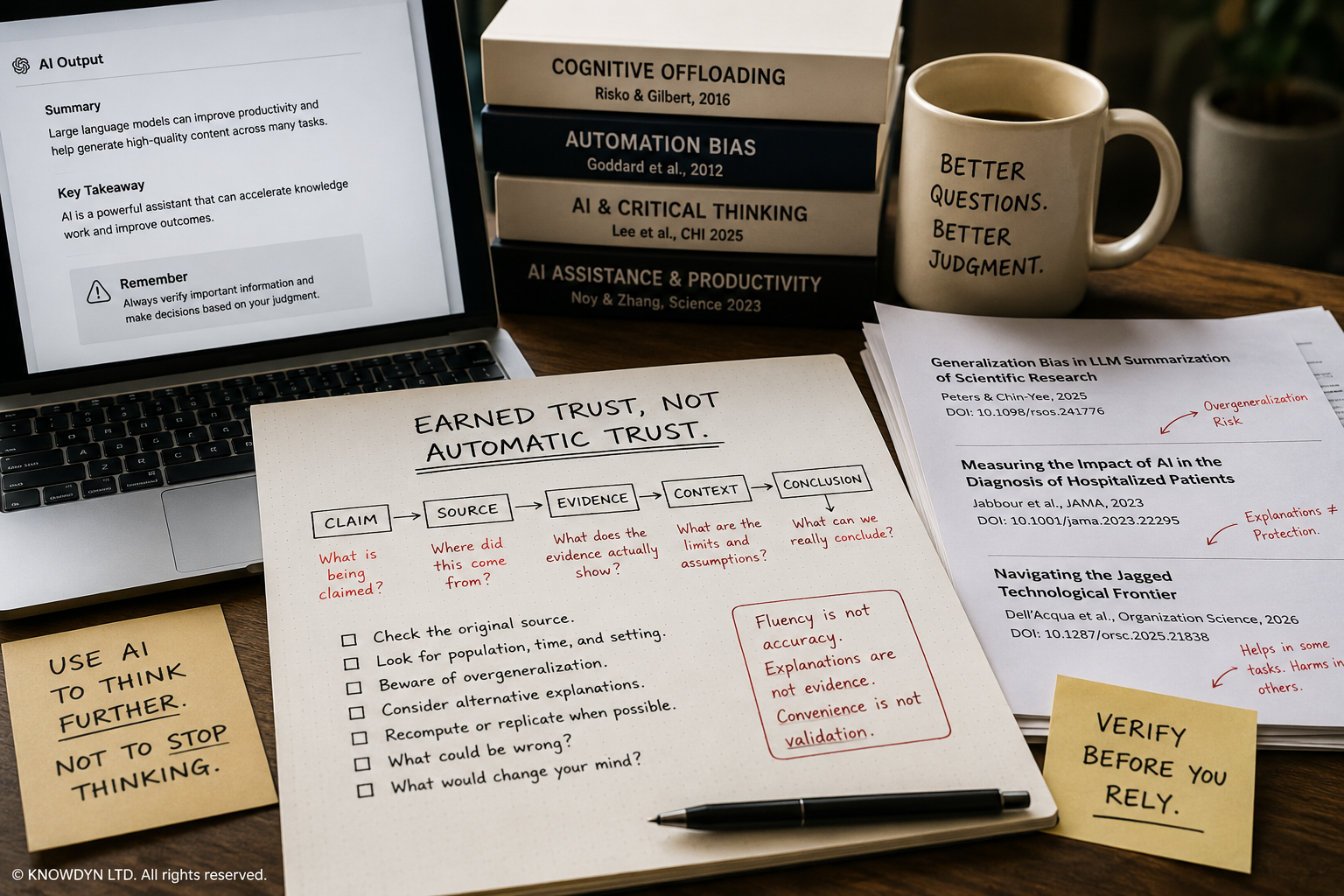
The hidden problem is earned trust
The hidden problem with AI is not only that it can hallucinate. The deeper problem is that it can make weak understanding feel complete before the human has done the work needed to deserve confidence.
That problem sits at the center of Adjoint Thinking. The first post explained why AI should extend human reach without replacing the human verdict, and the second post on AI for angel investors showed the same risk inside pitch screening, where a polished machine-generated memo can make an uncertain investment case look more coherent than the evidence allows.
This post explains the problem more directly. The concern is not a vague fear that AI will make people lazy, nor is it a simple claim that AI is unreliable, because the evidence reviewed in the book points to a more precise danger: AI can be genuinely useful while changing the user’s relationship to attention, effort, memory, explanation, and trust.
Productivity is real, and that is why the problem matters
The strongest argument for using AI is not imaginary. In a controlled experiment on professional writing tasks, Noy and Zhang found that access to generative AI reduced task completion time and improved average output quality.
For many knowledge workers, this matches lived experience. The machine can quickly produce a draft, summarize material, reorganize scattered notes, or give a structure when the mind feels overloaded.
That usefulness is exactly why the problem deserves attention. A useless system is easy to reject, but a useful system earns trust in small increments, especially when it repeatedly saves time under pressure.
When AI saves time repeatedly, the user may begin to treat speed as evidence that the process is working. That can be dangerous when the task has quietly shifted from drafting to deciding, from summarizing to interpreting, or from organizing material to determining what should be believed.
The jagged nature of AI capability makes this harder. In the field experiment published by Dell’Acqua and colleagues, AI assistance improved performance for tasks inside the system’s capability frontier but worsened performance for tasks outside it.
That finding matters because the boundary is not obvious to the user. Two tasks that feel similar from the outside may require very different levels of human verification.
The lesson is not that AI productivity is false. The lesson is that productivity gains do not automatically tell you whether the machine has touched the right part of the work.
A faster draft may be a good offload. A faster conclusion may be a premature verdict.
Cognitive offloading is useful until it reaches the wrong layer
Human beings have always offloaded cognition. We write notes, build tables, draw diagrams, save files, use calculators, create checklists, and rely on instruments because the unaided mind cannot hold everything at once.
Risko and Gilbert describe cognitive offloading as the use of external action or tools to reduce internal cognitive demand. That concept helps explain why AI feels so natural to overloaded professionals.
The issue is not whether cognitive offloading is good or bad. The issue is what exactly gets offloaded, because the machine may either free the human for judgment or quietly begin to occupy the place where judgment should happen.
If the machine helps retrieve, compare, format, or generate alternatives, it may free the human mind for higher-value decisions. If the machine begins to decide which uncertainty matters, which source deserves trust, or which conclusion should be accepted, then offloading has moved from assistance into authorship.
This distinction is central to the first two posts in this series. The definition post explained Adjoint Thinking as a way to place AI beside the human mind rather than above it, and the angel-investor post showed how the same distinction applies when a pitch deck becomes a memo that looks disciplined before the investment case has been verified.
The practical problem is that the boundary is easy to miss. A summary looks like a helper, an explanation looks like thought, and a polished recommendation looks like completed judgment.
When that happens, the user is not merely saving effort. The user may be outsourcing the very friction that would have revealed the hard part.
Critical thinking can fall when AI becomes the first move
The book’s concern about attention is not only philosophical. In a CHI 2025 study on knowledge workers, Lee and colleagues found that generative AI tools reduced the perceived effort of critical thinking and encouraged over-reliance, with the user’s confidence in AI and confidence in self shaping how much critical effort they reported using.
That result does not prove that every AI user becomes less thoughtful. It does support the narrower warning that AI can change how much effort people feel they need to spend.
A separate study by Gerlich investigated AI tool use, cognitive offloading, and critical thinking. The study reported a negative relationship between AI usage and critical-thinking scores, with cognitive offloading analyzed as a mediating factor.
The responsible reading is careful because survey and correlational evidence should not be inflated into a universal law. The useful reading is still serious because it suggests that repeated convenience can train the user’s cognitive posture.
The danger begins when AI becomes the first move rather than the second. If a reader asks for a summary before touching the source, the machine frames the material before the human has formed a first impression.
If a writer asks for the argument before feeling the contradiction, the machine may give structure before the difficulty has taught anything. This is why Adjoint Thinking protects first contact instead of treating the prompt as the first meaningful event.
The human should meet the problem enough to know where it hurts before asking the machine to help. Otherwise, the machine does not only assist the work; it quietly decides what the work feels like.
Summaries can distort without looking false
Hallucination is dramatic when a model fabricates a citation or invents a fact. The subtler danger is a summary that sounds accurate while changing the boundary of the claim.
A scientific result can be made broader, cleaner, and easier to remember than the original evidence permits. That is why summary quality should not be judged only by fluency or by whether the main topic appears to be correct.
This is the warning in the study by Peters and Chin-Yee, which found that large language models can overgeneralize scientific conclusions beyond what source texts justify. This kind of error is especially dangerous because it may not look like fabrication.
The same pattern appears outside science. A market report can become too broad, a legal rule can lose its jurisdictional boundary, a medical finding can lose its population limit, and a pitch deck can turn an exploratory pilot into evidence of demand.
In each case, the surface becomes cleaner while the truth becomes less exact. The summary is not useless, but it must be treated as orientation until the source has been checked.
Explanations can increase confidence without increasing truth
Many users trust AI more when it explains itself. That instinct is understandable because an explanation makes an answer feel inspected.
The problem is that an explanation may rationalize a wrong answer as smoothly as it supports a right one. An explanation is still generated language, and generated language can carry unsupported assumptions, missing boundaries, or a misleading sense of certainty.
The automation-bias literature warned about this problem before modern LLMs became widespread. In their systematic review, Goddard, Roudsari, and Wyatt describe automation bias as the tendency to over-rely on automated support and miss new errors that automated systems can introduce.
The key point is not that automation never helps. The key point is that users may become less vigilant precisely when support appears competent.
The clinical evidence reviewed in the book makes this especially concrete. In a randomized clinical vignette study published in JAMA, Jabbour and colleagues found that standard AI predictions improved diagnostic accuracy compared with baseline, but systematically biased AI predictions reduced accuracy, and explanations did not mitigate the negative effect of biased predictions.
That result matters outside medicine because it shows why explanation is not the same as protection. A generated explanation should therefore be treated as another claim-bearing object that needs a source, mechanism, boundary, and contradiction check when the answer carries consequence.
The real problem is earned trust
The evidence points toward a common pattern. AI can improve speed and quality in some tasks, reduce the burden on working memory, produce useful first drafts, and widen the field of possible thought.
The same system can also reduce critical effort, encourage careless offloading, overgeneralize sources, and make wrong answers more persuasive through fluent explanation. This is why the hidden problem with AI is not only hallucination, but earned trust.
Users often treat trust as a feeling that arrives when output looks coherent, useful, and calm. Serious work needs trust to become a procedure instead.
The procedure begins by asking what kind of object the machine has produced. A draft needs revision, a factual claim needs a source, a calculation needs recomputation, an explanation needs evidence, and a decision must return to responsibility.
Without this classification, all successful answers begin to feel like the same kind of success. Adjoint Thinking exists to make that classification habitual.
It does not ask the user to reject AI. It asks the user to decide where the machine belongs in the cognitive process, what status its output has earned, and which part of the final work still requires a human verdict.
The professional version of the problem
A researcher asks an LLM to summarize five papers before writing a review. The model compresses them elegantly, but it removes the population limits that made the papers difficult to compare.
The researcher feels oriented, yet the orientation has already narrowed the field. The machine has not only summarized the sources; it has shaped the terms of attention.
An engineer asks for a design rationale and receives a calm explanation with the right vocabulary. The answer may name real failure modes, but it may also miss the one boundary condition that decides whether the design is safe.
The prose sounds technical, but technical language is not technical validation. The real test is whether the explanation survives calculation, simulation, standards, and material constraint.
An angel investor uses a local model to screen a pitch deck and receives a clean investment memo. The memo separates market, traction, risks, and founder questions, but it may convert founder claims into investor language before the evidence has been checked.
The memo looks disciplined, yet the discipline may belong to the template rather than the decision. That is the problem explored in the earlier post on AI for angel investors.
A writer asks for a stronger argument and receives a structure that feels persuasive. The structure may help, but it may also make the writer forget the unease that signaled the real weakness.
The answer did not steal the work by being wrong. It stole the interval in which the work might have become honest.
In all these cases, the machine is not the villain. The failure is a mismatch between the role given to the machine and the trust granted to its output.
The model was allowed to do more than the user had consciously authorized. That is why the repair must happen at the level of cognitive workflow, not only at the level of wording a better prompt.
The repair is placement, not panic
A bad response to this evidence would be to panic and refuse all machine assistance. That response misunderstands the problem because the evidence does not say that AI is useless.
The evidence says that AI changes the distribution of cognitive labor. That means users need a discipline for placing that labor, especially when the output will influence public, professional, financial, technical, or responsibility-bearing work.
The first repair is to delay the machine until the human has made some first contact. This does not mean doing the whole task alone, but it does mean reading enough, sketching enough, questioning enough, or naming the pressure enough that the machine enters a relationship with human attention rather than filling a vacuum.
The second repair is to label the output before using it. A generated summary should be marked as orientation until the source is checked, a generated explanation should be marked as plausible until the mechanism is verified, and a generated recommendation should be demoted to material for judgment until the human can defend the decision without the machine present.
The third repair is to keep internal links between the method and real use cases. The general discipline is explained in What Is Adjoint Thinking?, while the investor case in AI for Angel Investors shows why a structured AI workflow can still fail if provenance, status, and final judgment are not protected.
Better prompts cannot solve this alone
Better prompts can reduce some failures. They can ask for sources, uncertainty, assumptions, objections, and alternative explanations.
They can also force a model to slow down and make seams more visible. That is useful, but it is not sufficient, because prompts operate inside the exchange while the deeper risk often begins before the exchange.
A user may ask a careful question from a state of fatigue, impatience, decision pressure, or desire for closure. The prompt may look disciplined while the cognitive posture behind it is still trying to escape the difficult part.
This is why Adjoint Thinking treats the human state as part of the workflow. The method asks what burden is being carried, which part of that burden is safe to share, which part must be verified, and which part must remain under human command.
If the machine is asked to help with memory, it should not quietly become the archive’s author. If it is asked to help with reasoning, it should not quietly become the verdict.
If it is asked to help with verification, it should not quietly become the source of trust. The prompt is only one instrument inside a larger discipline of authorship.
The future belongs to disciplined trust
The next stage of AI use will not be won by people who trust machines blindly. It will also not be won by people who refuse useful machines out of pride or fear.
It will belong to people who can create disciplined trust under pressure. Disciplined trust does not ask whether AI is good or bad in general, because that question is too blunt for serious work.
Disciplined trust asks what the output is, what it depends on, what it omits, where it could be wrong, how much consequence it carries, and what kind of verification it deserves. That is a much harder practice than writing a clever prompt.
The hidden problem with AI is that it can make a person feel finished before they have become responsible. It can make structure arrive before judgment, explanation before evidence, and fluency before truth.
Once that problem is understood, the solution becomes visible. The machine can help you think further than your unaided mind could comfortably reach, but it cannot decide what deserves your confidence, your signature, or your name.
That decision is still the human work. It is also the reason Adjoint Thinking is not a rejection of AI, but a discipline for using it without disappearing into it.