

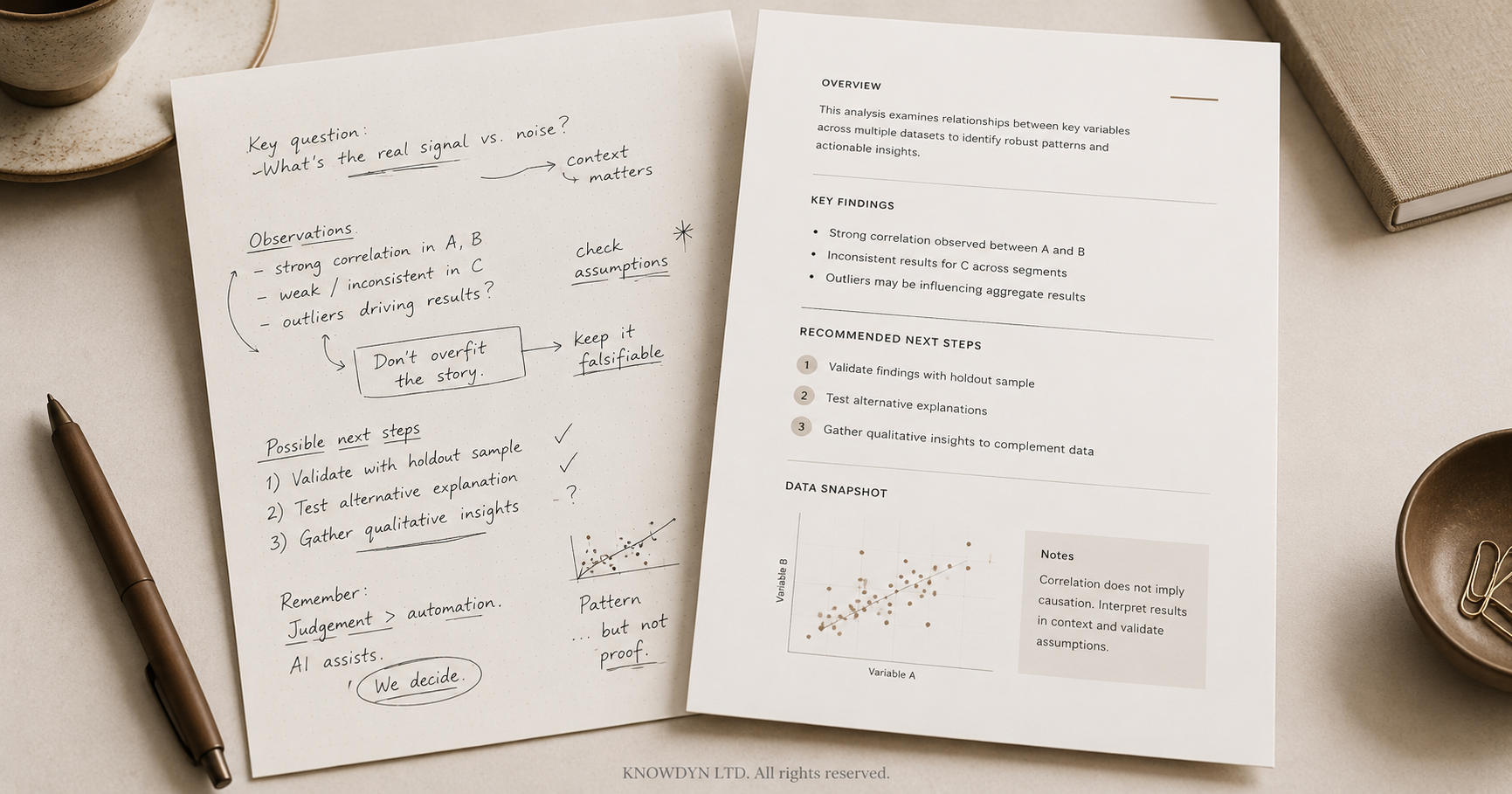
Adjoint Thinking is a method for thinking with machines without letting machine fluency replace human judgment.
It is not a prompt-engineering trick. It is not an anti-AI argument. It is not another productivity formula for producing more text with less effort.
It is a discipline for serious professionals who use AI in work that carries their name: researchers, engineers, founders, writers, analysts, teachers, inventors, artists, consultants, and knowledge workers who cannot afford to confuse a fluent answer with a trustworthy one.
The problem is not that AI is useless. The problem is that AI is useful at exactly the point where the overloaded mind is most vulnerable.
A clean AI answer can feel like relief. It can summarize a paper, organize a plan, draft an argument, name objections, compare options, or turn a scattered idea into fluent structure. But relief is not the same as understanding. A fluent answer is not a verified answer. A plausible outline is not yet a defensible structure. An output is not original work simply because it looks finished.
Adjoint Thinking begins there.
The Short Definition
Adjoint Thinking is a human-AI thinking framework that places the machine beside the human mind, not above it.
The machine is used to extend reach, reveal hidden assumptions, generate alternatives, organize fragments, test possible paths, and make difficult work more manageable. But the human remains responsible for the final judgment, the verification of claims, the meaning of the work, and the decision to publish, build, teach, sell, or sign.
Adjoint Thinking means using AI for reach while keeping the verdict human.
This matters because the next serious AI skill is not only knowing what to ask. It is knowing what not to outsource.
Why the Word “Adjoint” Matters
The word “adjoint” comes from mathematics and physics, where an adjoint object is paired with another object in a way that reveals hidden structure.
It is not the original object itself. It stands beside the original and helps expose something that could not be seen from the original direction alone.
That is the spirit of Adjoint Thinking.
The machine is not treated as a replacement mind. It becomes a companion structure. It reflects pressure back into usable form. It helps the thinker see assumptions, alternatives, contradictions, and possible paths.
But it does not become the author of the work.
This is the difference between using AI as a convenience and using AI as a disciplined cognitive environment.
Why Prompt Engineering Is Not Enough
Prompt engineering asks: “How do I get a better answer from the machine?”
Adjoint Thinking asks a deeper question: “What is this machine doing to my thinking?”
That second question matters more for serious work.
A researcher does not only need a better literature summary. She needs to know whether the summary preserved the method, population, caveats, and boundaries of the evidence.
An engineer does not only need a list of failure modes. He needs to know which ones are physically plausible, which require calculation, and which should be tested against standards.
A founder does not only need a sharper pitch. He needs to know whether the pitch has made the company sound more coherent than the market evidence allows.
A writer does not only need smoother prose. She needs to know whether the smoother sentence still belongs to her thought.
Prompting can improve output. It cannot, by itself, protect judgment.
The Modern Expert’s Problem Is Saturation
The crisis of the modern expert is not stupidity. It is saturation.
The serious professional is surrounded by too many papers, tabs, notes, drafts, claims, metrics, tools, obligations, and deadlines. The work is not always impossible because the person lacks intelligence. It becomes impossible because the work has exceeded the available mind.
This is why AI feels so powerful. It arrives when the mind is tired of holding too much.
It offers summaries when the literature feels endless. It offers plans when the project feels formless. It offers arguments when the page is empty. It offers confidence when the human system is short of it.
That help can be valuable. But it can also close the loop too early.
The danger is not that the machine answers. The danger is that it answers before the human has located the real pressure of the problem.
AI Is Not Just a Tool. It Is a Cognitive Environment.
Calling AI “a tool” is not wrong, but it is too weak.
A tool changes what you can do. A cognitive environment changes what you tend to become.
A language model does not simply wait for your intention. It changes the felt cost of beginning, continuing, checking, and staying uncertain. It can make a difficult task feel smaller. It can also make a premature answer feel complete.
That is why AI can make a person faster and shallower in the same week.
It can help you think beyond your unaided limits. It can also train you to stop performing the difficult acts that used to build understanding: reading before summarizing, sketching before generating, checking before citing, choosing before polishing, and doubting before accepting.
Adjoint Thinking treats AI as a cognitive environment that must be designed.
The better questions are:
- What part of this task should remain mine?
- What part can be safely shared with the machine?
- What part is dangerous until checked?
- What claims need evidence?
- What output is only private material?
- What decision must remain human?
The Three Zones of Machine-Assisted Work
A practical starting point is the three-zone map.
1. The Mine Zone
This is the part of the work that must remain under personal command.
It includes the reason the work matters, the final claim, ethical responsibility, taste, risk tolerance, the decision to sign, and the willingness to defend the result.
AI can help prepare this zone. It cannot own it.
2. The Shareable Zone
This is the part of the work that can be offloaded without surrender.
It includes listing assumptions, generating alternatives, comparing frameworks, proposing structures, creating checklists, translating a concept, drafting rough language, and simulating objections.
The machine is useful here because it widens the field on which human judgment can operate.
3. The Dangerous Zone
This is the part that may look shareable but requires verification before it travels.
It includes factual claims, citations, numerical results, recent events, medical or legal implications, technical specifications, causal explanations, safety judgments, and anything that will be published, taught, used, sold, or signed.
The dangerous zone does not mean “never use AI.”
It means: do not let machine fluency become public trust until it has earned it.
A Simple Adjoint Thinking Method
Use this short audit before bringing AI into serious work.
1. Name the Pressure Before the Prompt
Do not begin with the task. Begin with the pressure.
Not this:
“Write an outline for my paper.”
Better:
“This paper has evidence, but I cannot yet name the central distinction the field is missing.”
Not this:
“Create a business strategy.”
Better:
“This product solves a real pain, but I cannot tell whether the current positioning came from customers or from investor pressure.”
The machine becomes more useful when the human names the pressure first.
2. Assign the Machine a Role
Do not let the machine silently become the judge.
Name its role:
- Clerk: organize, format, compare, prepare.
- Critic: attack the idea, find weaknesses, expose assumptions.
- Generator: produce alternatives, analogies, titles, structures.
- Translator: move an idea into another register without changing meaning.
- Tutor: explain a concept while marking uncertainty.
- Simulator: model possible objections or reader reactions.
A role gives the machine jurisdiction. It prevents a helper from becoming a hidden author.
3. Separate Output From Trust
When the answer arrives, classify it.
Is it orientation, a draft, a hypothesis, a factual claim, a reasoning path, an analogy, a citation, or a decision recommendation?
Each type requires a different level of trust.
A metaphor may be useful as private material. A citation must be checked. A causal claim needs evidence. A decision must return to the human.
4. Verify What Can Travel
Before machine-assisted work leaves private thought and enters the world, ask three questions:
- What is the claim?
- Where is the source?
- What is the consequence if it is wrong?
This is the beginning of earned trust.
The aim is not to slow every act of work. The aim is to stop machine fluency from traveling farther than it deserves.
5. End With the Human Verdict
After the machine has helped, write the human verdict in plain language.
For example:
“I accept this structure as a working outline, but the central claim still needs source verification.”
“I reject the machine’s framing because it makes the project sound more settled than the evidence allows.”
“I will use this analogy privately, but I will not publish it as explanation until I test whether it misleads the audience.”
The verdict is where authorship returns.
What Adjoint Thinking Protects
Adjoint Thinking protects the faculties most easily weakened by ungoverned AI use.
It protects attention by preserving first contact with the problem before the machine frames it.
It protects memory by requiring provenance, so the user knows where claims, interpretations, and machine syntheses came from.
It protects reasoning by borrowing paths without accepting machine verdicts.
It protects imagination by using AI to generate possibilities without confusing possibility with truth.
It protects verification by refusing to let fluent answers travel farther than earned trust.
It protects synthesis by making the machine serve the work’s pressure rather than imposing a neat outline too early.
It protects invention by forcing output to meet constraint, test, use, and responsibility.
It protects sovereignty by keeping the final human decision visible.
What This Means for Serious Professionals
For researchers, Adjoint Thinking means AI can help map a literature without replacing the duty to inspect sources.
For engineers, it means AI can propose failure modes without certifying safety.
For founders, it means AI can sharpen strategy without inventing false market certainty.
For writers, it means AI can help revise language without stealing the private pressure that makes the work alive.
For teachers, it means AI can improve explanations without replacing the responsibility to preserve truth.
For artists, it means AI can generate variations without importing the necessity of the work.
For consultants and analysts, it means AI can structure materials without turning unverified assumptions into confident recommendations.
In every case, the central discipline is the same:
Use the machine to expand the field, then return the verdict to the human.
Research Spine
Adjoint Thinking builds on a long human habit of externalizing mental burden. Cognitive scientists describe this as cognitive offloading: using external actions, tools, or environments to reduce internal cognitive demand.
The risk is that powerful automated support can invite automation bias, where people over-rely on machine output or miss errors because the system appears authoritative.
Productivity evidence also matters. In a controlled professional writing experiment, Noy and Zhang found that access to generative AI improved average speed and output quality. That is exactly why discipline matters: the machine can be genuinely useful and still require human verification.
Why This Book Exists
Adjoint Thinking was written because the ordinary AI conversation is too small.
One side says AI will make everyone more productive. Another says AI will make everyone dependent or shallow. Both positions miss the more useful question:
Under what conditions does machine assistance strengthen human thought, and under what conditions does it weaken it?
The answer is not found in prompts alone.
It is found in a discipline of placement: what to offload, what to preserve, what to verify, what to transform, and what to refuse.
This is the problem Adjoint Thinking was written to solve.
If you use AI in work that carries your name, this is not only a productivity issue. It is an authorship issue.
The machine can extend your reach. It cannot decide what your work should be loyal to.
FAQ
What is Adjoint Thinking?
Adjoint Thinking is a method for using AI as a disciplined companion to human thought. It helps users offload cognitive burden while preserving judgment, verification, originality, authorship, and responsibility.
Is Adjoint Thinking the same as prompt engineering?
No. Prompt engineering focuses on getting better outputs from AI. Adjoint Thinking focuses on designing the human-machine thinking process so the user knows what to offload, what to verify, and what must remain human.
Who is Adjoint Thinking for?
It is for serious professionals whose work carries consequence: researchers, engineers, founders, writers, analysts, teachers, artists, inventors, consultants, and knowledge workers using AI in public or responsibility-bearing work.
Why is AI fluency risky?
AI fluency is risky because a generated answer can sound clear before it has earned trust. A fluent paragraph may still contain unsupported claims, missing boundaries, weak reasoning, or hidden assumptions.
What is the human verdict?
The human verdict is the final responsibility-bearing decision after AI has helped. It is the part of the work the machine can inform, challenge, or prepare, but cannot own.